UFIS Architecture
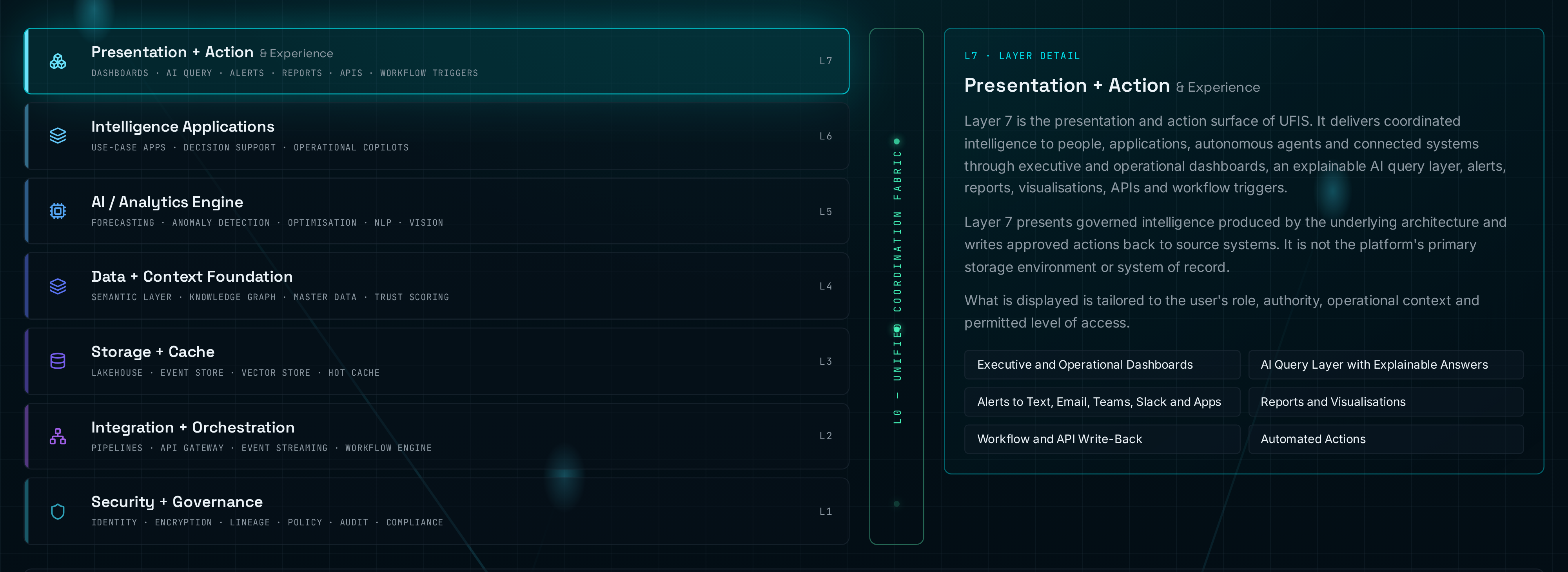
Layer 0 is the connection fabric. Layer 7 is the presentation and action surface. Storage and cache sit inside the data foundation.
Layer 7 is the presentation and action surface of UFIS. It delivers coordinated intelligence to people, applications, autonomous agents and connected systems through executive and operational dashboards, an explainable AI query layer, alerts, reports, visualisations, APIs and workflow triggers.
Layer 7 presents governed intelligence produced by the underlying architecture and writes approved actions back to source systems. It is not the platform's primary storage environment or system of record.
What is displayed is tailored to the user's role, authority, operational context and permitted level of access.
Storage is not a separate business layer: it is an implementation choice inside the Data + Context Foundation, with hot-cache, event and vector stores added where latency or cost demands it.
End-to-end: how a signal becomes an action
A signal enters through the Layer 0 connection fabric, is routed and orchestrated across the architecture, presented at Layer 7 and returned as a governed outcome event.
High-resolution PNG exports of the Layer 0 coordination fabric architecture and the end-to-end signal flow, sized for direct placement in investor and partner decks.

Architecture elements mapped to the Patent Position Document
Each element of the UFIS architecture on this page traces to specific sections, figures, code exhibits and claim-support passages in the UFIS Patent Position Document (HJMT Solutions Pty Ltd — draft, June 2026). 14 elements, 36 references.
Standardised connectors and agents receive measurable events from independent systems, OT/IoT, files and external open and closed data sources before any interpretation occurs.
Traceability references map site content to the draft Patent Position Document. The document supports a filed patent application; nothing here represents a granted patent.
Storage and cache inside the data foundation
UFIS does not rely on a single database technology. Operational intelligence requires many different data characteristics — high-frequency sensor readings, structured transactional records, unstructured documents, imagery, relationship structures, semantic representations and historical operational memory. UFIS therefore adopts a polyglot storage architecture in which each type of information is retained in the storage service most appropriate for it.
The Unified Signal Object provides a consistent intelligence representation across all of these storage services, allowing UFIS to coordinate information without forcing every form of data into a single technology. The architectural contribution of UFIS is not the choice of any individual storage technology, but the coordinated intelligence layer that unifies them into one governed operational model.
Platform characteristics
Flexible. Extensible. Future-ready.
Built for the cloud. Optimised for scale.
Security and governance built in, not bolted on.
Connects everything. Works everywhere.
Designed to deliver real-world impact.
Technology stack
Appendix C of the Strategic Platform Presentation.
Connectors, APIs, webhooks, event streaming, file ingestion, agents.
Lakehouse/warehouse, event store, vector DB, cache, knowledge graph.
Semantic mapping, entity resolution, data quality, lineage, confidence.
Forecasting, anomaly, optimisation, NLP/RAG, scenario simulation.
Dashboards, AI assistants, alerts, APIs, workflow automation, reporting.
UFIS is the subject of a patent application. Patent-pending status does not confer enforceable rights until and unless a patent is granted. No statement on this site should be read as a representation that a patent has been granted.